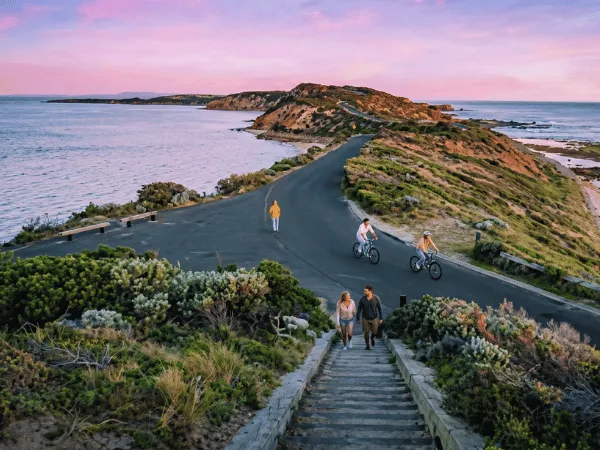
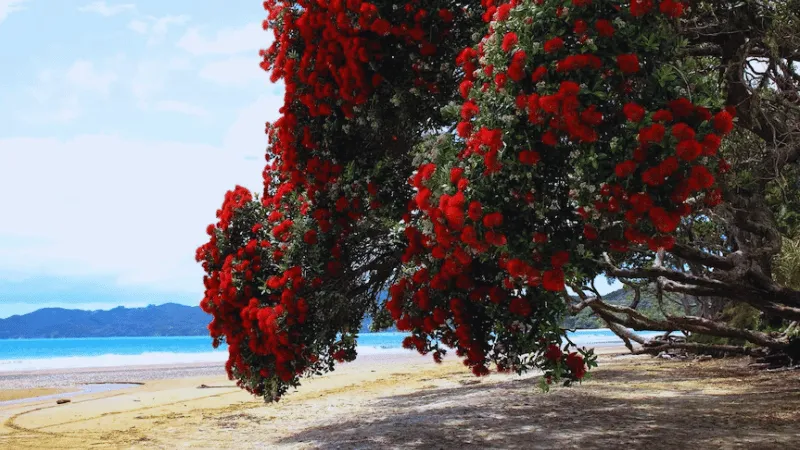
Every year, around the time Kiwis start hunting for jandals and booking the family bach, a coastline in New Zealand quietly turns red. Gnarled old trees lean over the sand, and their crowns fill with crimson flowers. Locals don’t need a calendar to know summer has arrived. They just look at the pōhutukawa.
Nowhere does this better than the Coromandel Peninsula, a couple of hours east of Auckland. This guide covers the Coromandel pōhutukawa season for summer 2026-27: when the trees usually flower, the best beaches, drives and walks to see them, and the practical details that changed after this year’s storms. Track and transport information was checked on 27 November 2026, so confirm the latest alerts before you set off.
Coromandel Pōhutukawa Season at a Glance
- Location: Coromandel Peninsula, Waikato region, North Island, New Zealand.
- Usual bloom window: from about late November or early December through to late January.
- Peak feeling: the weeks around Christmas, which is why New Zealanders call it their Christmas tree.
- Best areas: the Thames Coast road, northern Coromandel, Mercury Bay, Hahei and Hot Water Beach.
- Drive from Auckland: roughly 2 to 2.5 hours to the east coast beaches.
Why the Pōhutukawa Matters
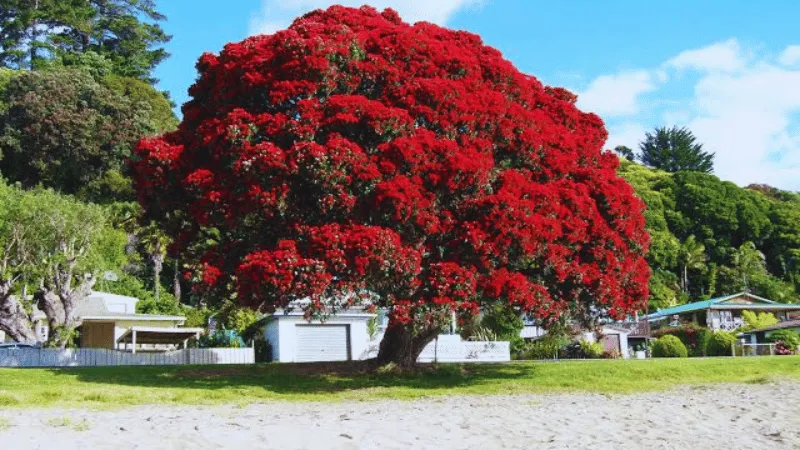
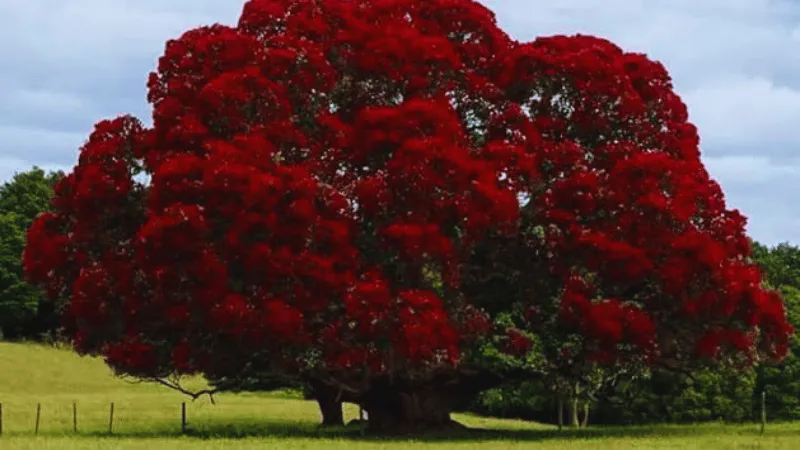
The pōhutukawa (Metrosideros excelsa) is a coastal tree native to New Zealand. It grows into a wide, dome-shaped giant, often clinging to cliffs with roots that snake over bare rock. Some trees can live for around a thousand years, according to Destination Hauraki Coromandel.
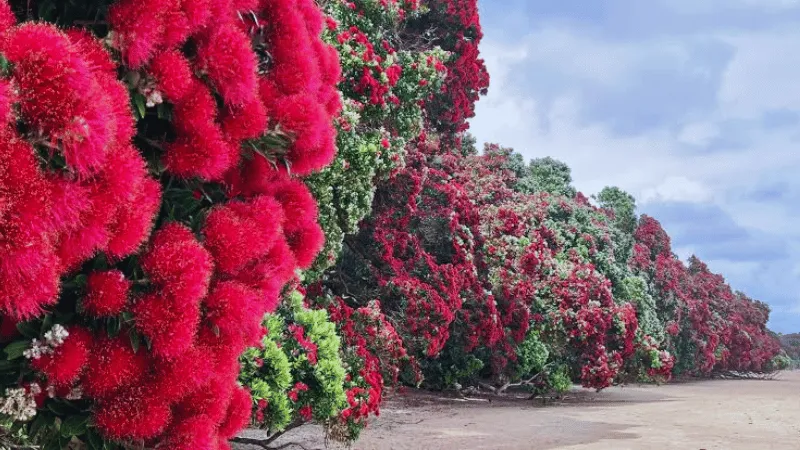
Here’s a detail most visitors miss. The flower has no real petals. What you see is a burst of bright red stamens, packed into fluffy clusters that glow against the dark green leaves. Tūī and bellbirds love the nectar, so a tree in full bloom is often noisy as well as colourful.
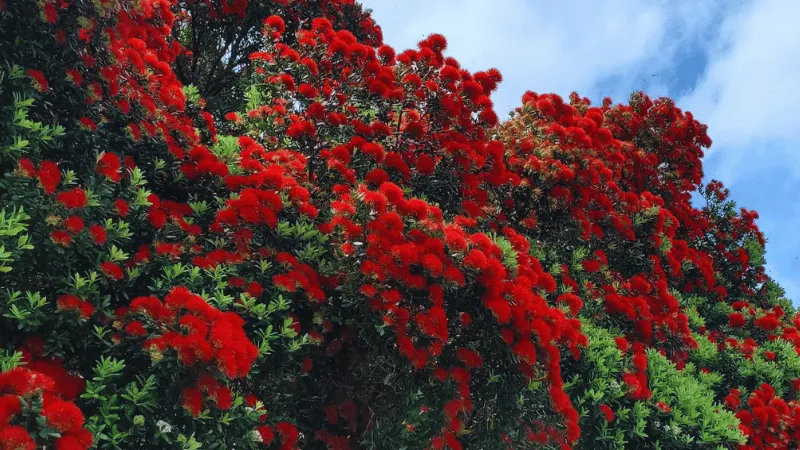
The tree also holds deep meaning in Māori tradition and in everyday Kiwi life. For many New Zealanders, a red pōhutukawa above a beach simply means summer holidays. That’s why you’ll see it on Christmas cards, in songs and in countless family photos.
When Do Pōhutukawa Flower?
Timing varies from tree to tree. University of Auckland botanist Bruce Burns told RNZ in December 2025 that pōhutukawa usually start flowering around the end of November or beginning of December, and trees keep flowering until the end of January. A single tree blooms for about a month, but its most intense show lasts roughly two weeks.
In practice, that’s good news for travellers. Because individual trees peak at different times, you’ll almost always find some in full colour between early December and mid-January. Trees in sheltered, sunny spots often flower first, while exposed headlands can lag behind.
Some years are also far better than others. In December 2023, Northland and the Coromandel saw what botanists described as a mast flowering, with conservationists calling it the most spectacular display in decades. Nobody can reliably forecast how strong the 2026-27 bloom will be, so treat any trip as a lovely summer escape with a chance of a brilliant show.
Best Places to See Pōhutukawa in the Coromandel
The regional tourism body, Destination Hauraki Coromandel, publishes a pōhutukawa trail with spots around the whole peninsula. These are the highlights worth building a trip around.
The Thames Coast Road
If you only do one drive, make it this one. State Highway 25 hugs the western shore of the Firth of Thames between Thames and Coromandel Town, and in summer it’s lined with flowering trees. Stop at Te Puru Domain, where one large tree has been recognised as historically significant, and at Waiomu Domain for a picnic under the branches with the firth as a backdrop.
In Thames itself, the coastal walkway runs past several old trees on its way to Victoria Park, which puts on one of the town’s best displays. The road is narrow and winding, so take it slowly and only pull over at proper stopping areas.
Coromandel Town and the Far North
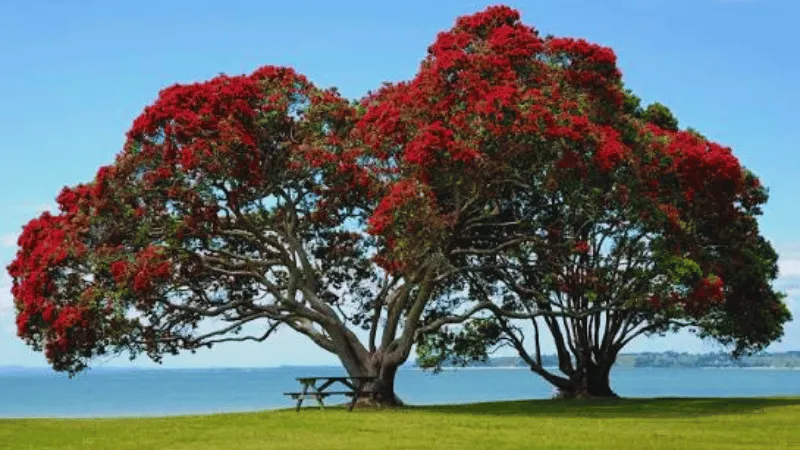
North of Coromandel Town, the coast gets wilder and the trees get older. At Oamaru Bay, a pōhutukawa planted in 1953 is known locally as “The Christmas Tree” and is one of the most photographed on the western side of the peninsula. Further north, the road weaves between twisted trunks at the foot of the Moehau Range. It’s slow going, but this is the Coromandel at its most unspoilt.
New Chum Beach (Wainuiototo)
New Chum Beach is a genuine hidden gem. There’s no road, no café and no shops, just a curve of pale sand framed by pōhutukawa from one end to the other. You reach it on a walk of about 30 minutes each way from the northern end of Whangapoua Beach, which includes a stream crossing and a rocky section.
Tide timing matters here. Local visitor information advises against walking in during the two hours either side of high tide. There are no toilets or lifeguards, so bring everything you need and take your rubbish home.
Mercury Bay and Whitianga
Whitianga is the main town on the eastern side, and it’s an easy base. Look for big trees around Soldiers Memorial Park and along the estuary near Lovers Rock. North of town, Wharekaho (Simpsons) Beach has a short walkway with four of the largest pōhutukawa in Mercury Bay. Meanwhile, Stella Evered Memorial Park at Cooks Beach holds dozens of ancient trees.
Hahei Beach and Te Pare Point
Hahei is usually rushed through on the way to Cathedral Cove, which is a shame. Its long beach is lined with pōhutukawa, and the short walk to Te Pare Point at the southern end leads to the remains of two historic pā sites with views back along the whole bay. Go late in the afternoon, when the light warms up the red flowers.
Tairua, Whangamatā and the Southern Beaches
The southern half of the east coast is quieter but just as pretty. At Sailors Grave near Tairua, branches hang over the beach and give welcome shade. Opoutere’s road follows an estuary fringed with trees, and Whangamatā’s harbour front is lined on both sides. If you want flowers without crowds, this stretch is a strong choice.
Cathedral Cove in Summer 2026-27: What’s Open
Mautohe Cathedral Cove is the peninsula’s most famous sight, and its sea arch is framed by pōhutukawa that flower bright crimson in December and early January, according to the Department of Conservation (DOC). However, the area has had a rough few years, so check the details before you go.
Current Track Status
Walking access was restored in December 2024 after major storm damage in 2023. Then a severe storm in late January 2026 closed the track again. DOC repaired the main route, and the Mautohe Cathedral Cove Track from Grange Road was open when we checked on 27 November 2026.
Several side routes are a different story. DOC has confirmed that walking access to Te Karaka/Stingray Bay will not be reinstated, and that the Waimata/Gemstone Bay track will not be repaired again. The old coastal track from Hahei Beach is also closed, although DOC said in October 2026 that it is working with the local community on a possible reroute. Both bays can still be reached from the water in good conditions.
Getting to the Track
There’s no parking at the Grange Road track entrance. Instead, park for free at the Hahei Visitor Car Park and either walk uphill for about 30 minutes or take the Cathedral Cove Park & Ride shuttle. Between 1 October and 30 April, it runs daily from 9am to 6pm, including Christmas Day. A return ticket costs NZ$8 for adults, children aged 14 and under ride free, and the operator asks you to buy tickets only on the day you travel.
Alternatively, the private Cathedral Cove Gateway Trail at 150 Lees Road offers paid parking and joins the main track partway. From the track entrance, DOC lists the walk at about 1 hour 30 minutes return. It’s sealed but has steep sections and steps.
Rules and Safety at the Cove
- Don’t visit during or right after heavy rain. DOC closes the track and the shuttle stops when an orange or red weather warning covers Hahei.
- Go near low tide, move quickly through the arch and don’t sit directly under the cliffs.
- There’s no drinking water on the track or at the beach. Fill up at the Hahei Visitor Car Park and carry 1 to 2 litres per person.
- Drones need a permit, there are no rubbish bins, and all marine life is protected within the marine reserve.
For live alerts, use the official DOC page for Mautohe Cathedral Cove Track on the morning of your visit.
Pair the Bloom with Hot Water Beach
Hot Water Beach sits a few minutes’ drive south of Hahei, and it makes a perfect second stop. Within two hours either side of low tide, you can dig a hole near the rocks at the southern end and let hot spring water seep up through the sand. Tourism New Zealand notes the water can reach 64°C, so mix in cool seawater before you settle in.
Pōhutukawa grow around the main car park and reserve, including two trees with unusual yellow flowers. Bring a spade or hire one locally. Above all, don’t swim casually here. The beach is known for strong rips and big waves, even on calm-looking days.
Photography Tips for Pōhutukawa Season
Crimson flowers can look flat in harsh midday sun, so aim for early morning or late afternoon. On the east coast, sunrise lights up trees facing the Pacific. On the Thames Coast, sunset over the firth works better. Shoot from beneath a tree to frame the sea through the branches, or use a longer lens to pick out flower clusters against blue water.
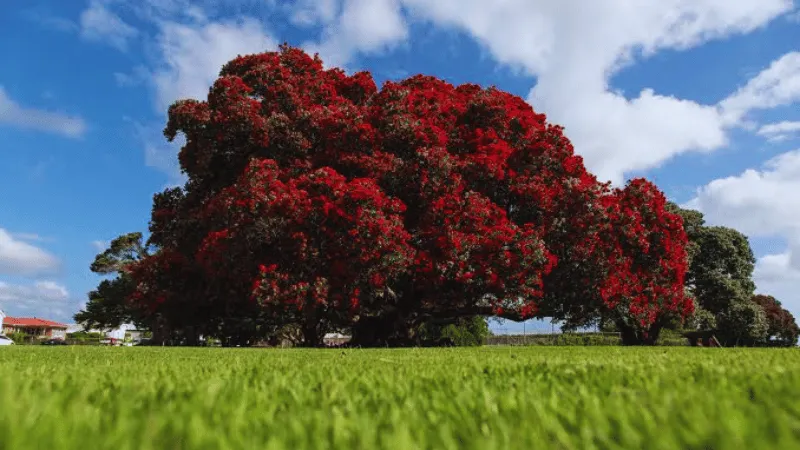
Please don’t climb the trees or park on their roots. DOC has warned that cars parked on pōhutukawa roots can damage the trees, and many of these specimens are a century or more old.
Travel Tips
Best Time to Visit
For flowers, aim for early December to mid-January. However, the Coromandel is a classic Kiwi holiday spot, so the weeks between Christmas and mid-January get very busy. Accommodation fills early and car parks overflow. Early to mid-December often gives you good colour with far fewer people. Late January can still work, although many trees will have dropped their flowers by then.
How to Reach the Coromandel
Most travellers fly into Auckland and drive. Thames is the gateway, and from there State Highway 25 loops around the peninsula, while State Highway 25A cuts across the middle to Whitianga, Hahei and Hot Water Beach. Allow around two and a half hours from Auckland to the east coast beaches. Driving is by far the easiest option, since public transport around the peninsula is limited.
Storms in early 2026 closed several sections of State Highway 25 for days at a time. Before any long drive, check the NZ Transport Agency journey planner for closures and roadworks.
Things to Know
- New Zealand’s summer sun is strong. Wear a hat, sunscreen and a long-sleeved top, and bring shade for the beach.
- Many beaches are unpatrolled. Swim only where you feel confident, and supervise children closely.
- Keep a tide app handy. New Chum Beach, Cathedral Cove and Hot Water Beach all depend on the tide.
- Mobile coverage drops out in the far north of the peninsula, so download offline maps.
- Ngāti Hei hold mana whenua over the Cathedral Cove area. Treat the land, sea and cultural sites with respect.
A Sample Two-Day Pōhutukawa Route
Day one: leave Auckland early and drive to Thames. Walk the coastal walkway to Victoria Park, then follow the Thames Coast road north, stopping at Te Puru and Waiomu. Have lunch in Coromandel Town, detour to Oamaru Bay, then cross to Whangapoua for the walk to New Chum Beach, timed around the tide. Spend the night in Whitianga.
Day two: catch the first Park & Ride shuttle from Hahei and walk to Cathedral Cove before the heat and crowds build. Afterwards, wander Hahei Beach to Te Pare Point. Finish at Hot Water Beach for the low tide window, then drive home via State Highway 25A.
More New Zealand and Southern Summer Escapes
Want another New Zealand flower spectacle? Our Lake Tekapo lupins guide covers the South Island’s colourful early-summer bloom. For mountain views, the Hooker Valley Track is the country’s best easy walk.
Across the Tasman, you can pair your trip with the white sand of the Wineglass Bay walk in Tasmania, or catch a very different seasonal event with the Christmas Island red crab migration.
Final Thoughts on the Coromandel Pōhutukawa Season
The Coromandel pōhutukawa season isn’t a ticketed event or a single viewpoint. It’s a whole coastline slowly catching fire, one old tree at a time. That’s exactly what makes it special. You can find it on a famous walk like Cathedral Cove, or under a lone tree on an empty beach that no guidebook mentions.
Go in early December if you can, keep an eye on the tides and the weather, and give yourself time to stop. Sooner or later, you’ll find your own favourite tree.
Time-sensitive information: track status, shuttle prices and hours, and road information were checked on 27 November 2026. Flowering times are based on typical seasonal patterns and vary each year. Confirm current details with DOC, the shuttle operator and NZTA before you travel.
Explore More Destinations
Looking for more seasonal inspiration? Browse LessExplore’s worldwide travel guides to hidden gems, waterfalls, coastal walks and scenic escapes. Head to Asia for the Hoi An International Lantern Festival in December, or swap summer for snow in our guide to the Abisko northern lights.
FAQ Section
Pōhutukawa usually start flowering around late November or early December and continue until the end of January. Each tree blooms for about a month, with its most intense colour lasting roughly two weeks, so early December to mid-January is the safest window.
The Thames Coast road between Thames and Coromandel Town is the classic drive. Other highlights include Oamaru Bay, New Chum Beach, Whitianga, Cooks Beach, Hahei Beach, Hot Water Beach and Cathedral Cove.
Yes. The main Mautohe Cathedral Cove Track from Grange Road reopened after the January 2026 storm and was open when checked on 27 November 2026. The side tracks to Stingray Bay and Gemstone Bay remain closed. Always check DOC alerts before visiting.
The Cathedral Cove Park & Ride shuttle costs NZ$8 return for adults, and children aged 14 and under ride free. From 1 October to 30 April it runs daily from 9am to 6pm from the free Hahei Visitor Car Park.
The drive from Auckland to the Coromandel’s east coast beaches, such as Hahei and Hot Water Beach, takes around two and a half hours. Thames, the gateway town, is closer. Check the NZTA journey planner for closures before you go.