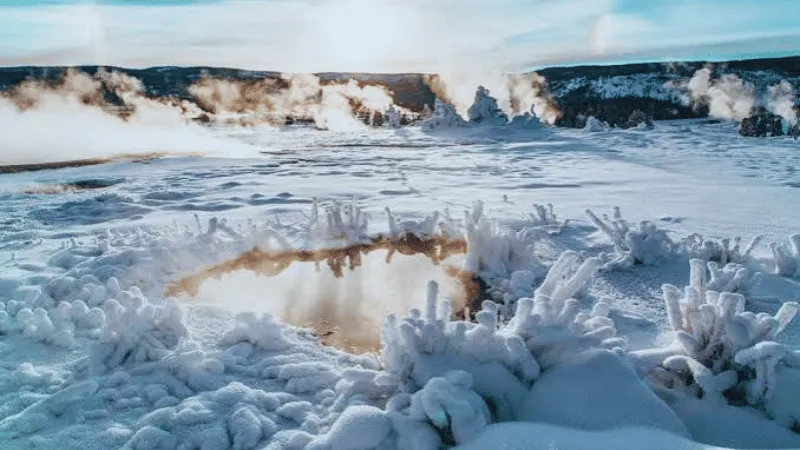
Steam rolls off a geyser basin into air that’s well below freezing. Bison plod through snow with frost on their beards. In the Lamar Valley, a line of spotting scopes swings toward a ridge where a wolf pack has just appeared. This is Yellowstone in winter, and it feels like a completely different park from the crowded summer version.
It’s also a park that needs more planning. Most roads close to cars, nearly every hotel shuts, and the interior is reachable only by snowcoach or guided snowmobile. This guide explains how Yellowstone in winter works for the 2026-27 season: the open road, oversnow dates, where to stay, what it costs and how to stay safe in serious cold. Dates and prices were checked on 27 November 2026 and can change, so confirm them before you book.
Yellowstone in Winter at a Glance
- Location: mostly northwest Wyoming, with edges in Montana and Idaho, USA.
- Oversnow season: 15 December 2026 to mid-March 2027, depending on the road.
- Open to cars all winter: only the road from the North Entrance at Gardiner to the Northeast Entrance near Cooke City.
- Lodging inside the park: Mammoth Hot Springs Hotel and Old Faithful Snow Lodge.
- Typical temperatures: roughly -20°C to -5°C (0°F to 20°F) through the day, colder at night.
Why Visit Yellowstone in Winter?
Yellowstone became the world’s first national park in 1872. It sits on top of an active volcanic system, which feeds more geysers and hot springs than anywhere else on Earth. In summer, those features compete with traffic jams and packed boardwalks. In winter, the crowds thin dramatically and the landscape turns quiet.
The cold also makes the thermal areas more dramatic. Hot water meets freezing air, so steam clouds rise higher and linger longer. Nearby trees become “ghost trees”, coated in thick rime ice from the drifting vapour. Meanwhile, deep snow pushes elk, bison and bighorn sheep down to lower ground, where they’re easier to see against the white backdrop.
For many visitors, though, the big draw is wolves. Gray wolves were reintroduced to the park between 1995 and 1997, and winter remains one of the best times to watch them hunt and travel across open valleys.
How Yellowstone Works in Winter
Understanding the road system is the key to planning. Most park roads and the West, South and East entrances closed to regular vehicles on 1 November 2026. Crews then groom the snow-covered roads for oversnow travel, which begins on 15 December.
The One Road You Can Drive
Only one road stays open to ordinary cars all year. It runs from the North Entrance at Gardiner, Montana, past Mammoth Hot Springs and Tower Junction, through the Lamar Valley and out to the Northeast Entrance near Cooke City. Beyond Cooke City, the highways east are closed or snow-only in winter, so the road is effectively a dead end. Plan to drive back the way you came.
This road is your ticket to Mammoth’s terraces and the Lamar Valley without a tour. Even so, conditions can be icy. Carry winter gear in the car, and check the official Yellowstone road status page before every drive.
2026-27 Oversnow Dates
Snowcoaches and snowmobiles reach the interior on groomed roads. However, segments close on different dates as spring plowing begins. The National Park Service projects these dates for the 2026-27 season:
- Mammoth Hot Springs to Norris: 15 December 2026 to 7 March 2027.
- Norris to Madison, Norris to Canyon, and Canyon to Washburn Hot Springs Overlook: 15 December to 9 March.
- Canyon to Fishing Bridge: 15 December to 14 March.
- West, South and East entrances and remaining groomed roads: 15 December to 15 March.
All dates depend on weather. In practice, travelling from the north side becomes difficult after early March, so aim for December to February if you want the full range of options.
Best Things to Do in Yellowstone in Winter
Watch Wolves in the Lamar Valley
The Lamar Valley sits along the open road, so you can drive there yourself. Arrive at first light, when wildlife is most active. Look for clusters of parked cars and spotting scopes in the pullouts, as experienced watchers often know where packs have been seen. Bring binoculars at minimum, because wolves are usually far away.
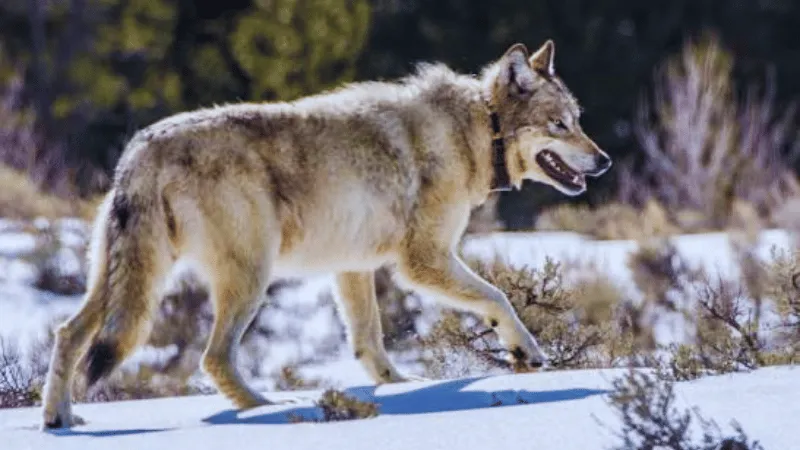
You’ll likely see bison, elk, coyotes and eagles too. Some visitors also spot foxes hunting by diving headfirst into the snow. If you’d rather not guess, guided wildlife tours from Gardiner and Mammoth bring scopes and local knowledge.
See Old Faithful Without the Crowds
Watching Old Faithful erupt in winter feels special. Instead of thousands of people, you might share the boardwalk with a few dozen. The steam column often towers far higher in cold air. Afterwards, walk or snowshoe around the Upper Geyser Basin, where hot pools glow against fresh snow.
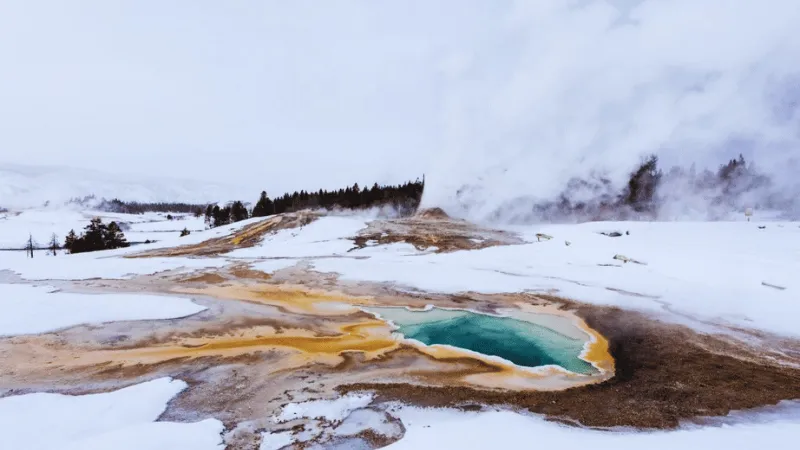
You can reach Old Faithful only by snowcoach, guided snowmobile or skis. Day trips leave from West Yellowstone and Mammoth, or you can stay overnight at Old Faithful Snow Lodge.
Explore Mammoth Hot Springs
Mammoth is the easiest winter base. Boardwalks climb past travertine terraces that look like frozen waterfalls, with steam curling off the warm stone. Nearby, you can take a self-guided walk through the historic buildings of Fort Yellowstone. The Albright Visitor Center stays open all year and is a good place to ask about trail and road conditions.
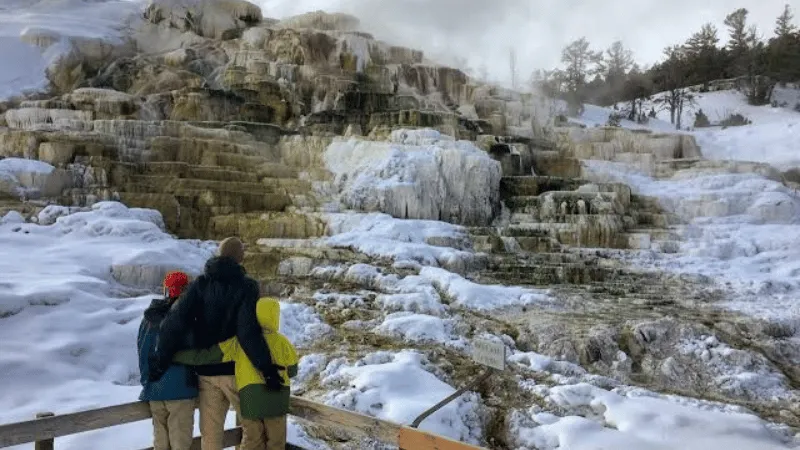
Cross-Country Ski and Snowshoe
Some of Yellowstone’s best winter moments come on skis or snowshoes. Several trails start along the open northern road, and more begin near Old Faithful. One popular route follows a groomed path to Lone Star Geyser. Lodges rent equipment and run ski drop-off shuttles to trailheads.
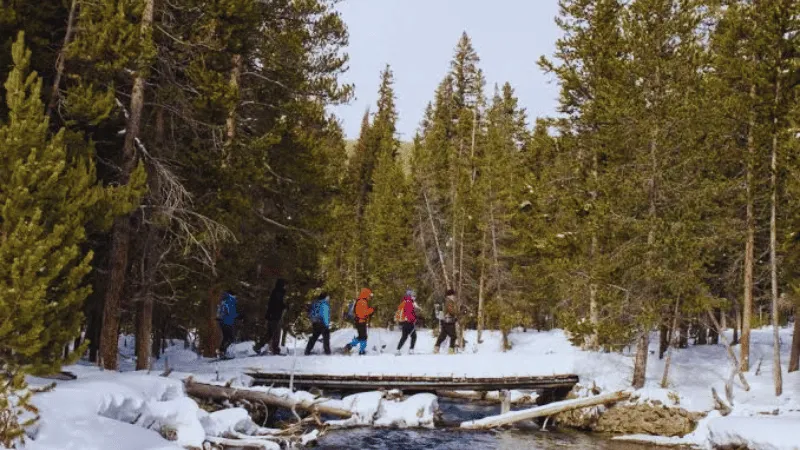
On trails, don’t walk on ski tracks, and snowshoe alongside them instead. Detour widely around wildlife. Bison often use packed trails and roads because walking in deep snow costs them energy.
Ride a Snowcoach or Snowmobile
Snowcoaches are heated vehicles on huge tyres or tracks. They’re comfortable, they let you focus on the scenery, and drivers double as guides. Popular routes visit Old Faithful and the Grand Canyon of the Yellowstone, where the frozen Lower Falls is a winter highlight.
Snowmobiling is more adventurous. All snowmobiles must travel with an authorised commercial guide unless you hold a permit from the Non-Commercially Guided Snowmobile Access Program. That program allows only four independent groups a day, one per oversnow entrance, through a lottery. The 2026-27 lottery opened on 1 August, and leftover dates appear on Recreation.gov.
Photography and Scenic Views
Winter gives photographers soft, low light all day. Frost-covered bison, rime-coated trees and steam backlit by the morning sun make strong images. The Lamar Valley at dawn and the geyser basins around Old Faithful are the classic spots. The Grand Canyon of the Yellowstone, with ice building up around the Lower Falls, is another favourite for snowcoach visitors.
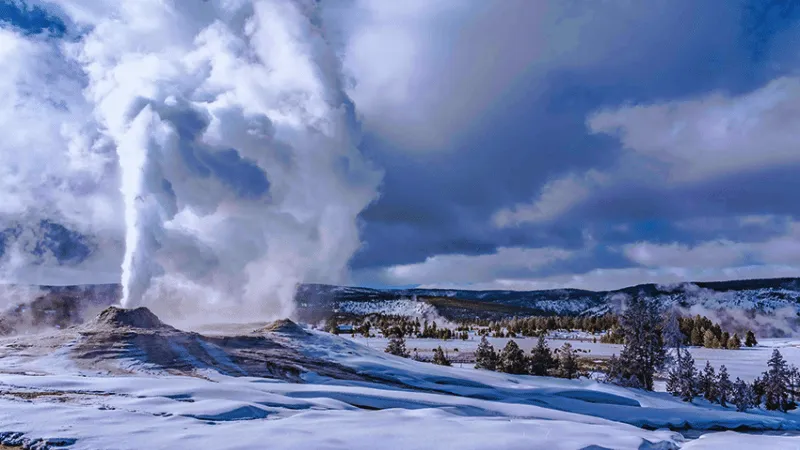
Cold drains batteries quickly. Keep spares in an inside pocket, and let your camera warm up slowly in a sealed bag when you go indoors to avoid condensation. Finally, use a telephoto lens for wildlife rather than walking closer.
Best Time to Visit Yellowstone in Winter
Each part of the season has its own character.
- Late December: the season starts, wildlife moves to lower ground and bighorn sheep are in their rut. The Christmas and New Year period is the busiest time, so lodging sells out early.
- January: the National Park Service lists it as the least busy month. Expect the deepest cold and the most dramatic steam.
- February: longer days and a reliable snowpack make it a favourite for skiing and photography.
- Early March: roads begin closing for plowing, so options shrink quickly.
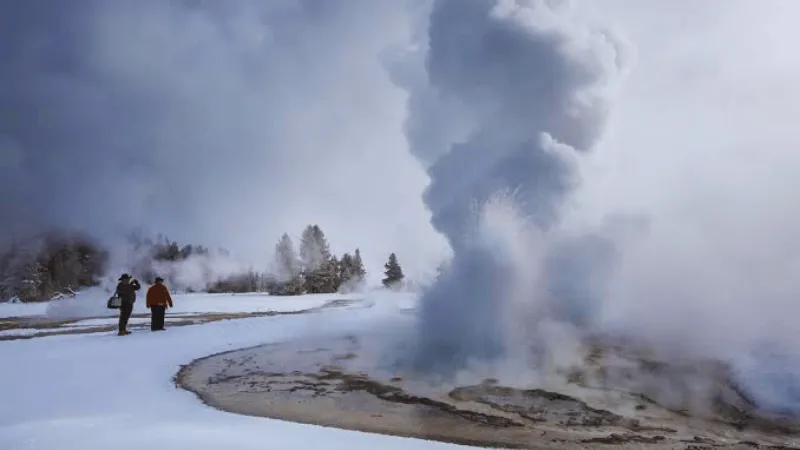
Weather is the wild card. The park says winter temperatures usually range from about -20°C to -5°C (0°F to 20°F), with sub-zero nights common at higher elevations. The record low is -54°C (-66°F), measured near the West Entrance in 1933.
Where to Stay
Only two hotels operate inside the park in winter, and both fill fast.
- Mammoth Hot Springs Hotel: reachable by car on the open northern road, which makes it the simplest base for wildlife watching.
- Old Faithful Snow Lodge and Cabins: open from 16 December 2026 to 7 March 2027, according to the park lodging operator. You can only get there by oversnow transport.
The Mammoth Campground stays open year-round on a first-come, first-served basis, but only for well-equipped winter campers. Outside the park, the gateway towns of Gardiner, West Yellowstone and Cooke City offer more choice and often lower prices.
How to Reach Yellowstone in Winter
Bozeman Yellowstone International Airport in Montana is the most practical gateway. From there, drive south to Gardiner and the North Entrance. Alternatively, skip the winter driving: the park lodging operator runs a daily winter shuttle between the airport and Mammoth Hot Springs Hotel from 16 December 2026 to 8 March 2027. It takes about two and a half hours and costs US$115.25 one way for adults.
To reach Old Faithful from Mammoth, take the daily snowcoach run by Yellowstone National Park Lodges. It operates from 16 December 2026 to 7 March 2027 and costs US$179.45 one way for adults and US$89.72 for children aged 3 to 11. Guests must spend a night in Mammoth before the morning departure.
West Yellowstone is the other main hub. Several companies there run daily snowcoach and snowmobile trips to Old Faithful and the Grand Canyon of the Yellowstone. Book well ahead for holiday dates.
Entrance Fees for 2026-27
According to the National Park Service fees page for Yellowstone, a private vehicle pass costs US$35 and a snowmobile pass costs US$30. Both last seven days. Visitors on foot or skis pay US$20 per person aged 16 or over.
International travellers should note a big change. Since 1 January 2026, non-US residents aged 16 and over pay an extra US$100 per person on top of the standard fee. This applies to tour and snowcoach passengers too. The only way around it is an annual pass, such as the US$250 America the Beautiful Nonresident Annual Pass. If you’ll visit several major US parks within a year, that pass usually works out cheaper.
Winter Safety and Things to Know
Dress for Real Cold
- Wear layers: a thermal base, warm mid-layer and windproof outer shell.
- Pack insulated waterproof boots, warm socks, a hat, a neck gaiter and mittens.
- Bring traction aids for your boots, since boardwalks near thermal areas get icy.
- Carry high-energy snacks and water. Your body burns more fuel staying warm.
Respect Wildlife and Thermal Areas
Park rules require you to stay at least 100 yards (91 metres) from bears and wolves and 25 yards (23 metres) from other animals, such as bison and elk. Winter is a hard season for wildlife, so every unnecessary disturbance costs them precious energy. Never step off boardwalks in thermal areas either. Thin crusts can hide scalding water, and snow makes edges harder to judge.
Plan for Limited Services
Most stores, restaurants and visitor centres close for winter. Fill your fuel tank before entering and carry extra food. Warming huts at spots such as Madison, West Thumb and Canyon offer shelter during oversnow trips, but check winter operating dates first. Mobile coverage is patchy, so download the free NPS app and offline maps before you arrive.
Two Parks, Two Fees
Arriving by snowcoach from the south via Jackson? You’ll pass through Grand Teton National Park first, which charges its own entrance fee. Budget for both.
Pair Your Trip with Other Winter Escapes
Want warmth instead of snow? Our guide to Death Valley in winter covers another US national park that’s at its best in the cooler months. If mountain lakes are more your style, plan a summer trip using our guide on how to visit Moraine Lake in Banff.
Wildlife lovers can also head south. From late November, millions of butterflies cluster in the forests covered in our guide to the monarch butterfly sanctuaries in Mexico.
Final Thoughts on Yellowstone in Winter
Yellowstone in winter asks more of you than a summer trip. You’ll need to book a snowcoach or tour, secure one of two in-park hotels early and pack for deep cold. In return, you get steaming geyser basins with few people around, frost-covered bison and a real chance of watching wolves in the Lamar Valley.
Start with a few nights at Mammoth for wildlife, then ride a snowcoach to Old Faithful for the geysers. Keep a flexible day for bad weather, and you’ll see a side of America’s first national park that most visitors never experience.
Time-sensitive information: road dates, lodging dates, fees and shuttle prices were checked on 27 November 2026. The National Park Service and park concessioners can change them at short notice, so confirm details directly before you travel.
Explore More Destinations
Craving more snowy adventures? Browse LessExplore’s worldwide travel guides to hidden gems, waterfalls, hiking trails and scenic escapes. Chase the aurora in Swedish Lapland with our Abisko northern lights guide, or see fairy chimneys dusted with snow in our guide to Cappadocia in winter.
FAQ Section
Yes. The park is open all year, but most roads close to cars from early November. The road from the North Entrance at Gardiner to the Northeast Entrance near Cooke City stays open to vehicles, and the interior opens to snowcoaches and guided snowmobiles from 15 December to mid-March.
No. The road to Old Faithful is closed to regular vehicles in winter. You can reach it by snowcoach, guided snowmobile or skis. Day tours leave from West Yellowstone and Mammoth Hot Springs.
Two hotels operate in winter: Mammoth Hot Springs Hotel, which you can reach by car, and Old Faithful Snow Lodge, which is open from 16 December 2026 to 7 March 2027 and reachable only by oversnow transport. Mammoth Campground also stays open on a first-come, first-served basis.
The Lamar Valley in the northeast of the park is the best-known spot. It lies on the road that stays open all winter, so you can drive there yourself. Go at dawn, bring binoculars or a spotting scope, and keep at least 100 yards from wolves.
A private vehicle pass costs US$35 and a snowmobile pass costs US$30, each valid for seven days. Since 1 January 2026, non-US residents aged 16 and over also pay a US$100 per person fee unless they hold an annual pass such as the US$250 Nonresident Annual Pass.